
National Coordinating Center

Funding Discussion: College-based Transition Services Affinity Group

The purpose of this affinity group is to support members whose work involves supporting transition-aged students with intellectual or developmental disabilities who are or who would like to include college in their transition services. The October meeting will include a discussion of funding options (Memorandums of Agreement with Vocational Rehabilitation, capitalizing on pre-ETS, examples of schools using IDEA funds, etc).

Mentors are often used to support students with intellectual disability as they transition to college. They are typically other college students who assist with academics, adjusting to college life, connect these new college students to campus clubs, organizations, and services, and support them to engage in campus activities. Such mentor models are as diverse as the institutions in which the students are enrolled.

Project
National Coordinating Center

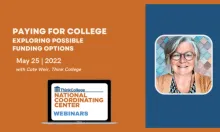
As students and their families look at college options, the question of how to pay for it is on everyone’s mind. No one solution is going to work for all students, so this webinar shares information on several funding options that students and families can explore, such as Vocational Rehabilitation, Medicaid, scholarships, federal student aid, Veteran’s benefits, and ABLE accounts. Details of each funding source are shared, as well as an overview of the conditions under which available funding possibilities may be an option.

Project
National Coordinating Center

College students in general have an immense amount of freedom to take emotional, physical, and intellectual risks. Presenters discussed the access to Dignity of Risk that students with intellectual disability should have when in college. The presenters advocated for increased dignity of risk, a model of dignity of risk in IPSE programming, and five principles that might guide programs as they consider and assess risk.

Project
National Coordinating Center