Accreditation

Accreditation ensures the quality of higher education, providing students with an acceptable educational experience. Program accreditation standards guide colleges and universities in developing and improving programs, validating them within institutions, and assuring students and families of their quality. 

Accreditation standards for postsecondary education (PSE) programs for students with intellectual disability (ID) have been developed, piloted, and refined. Soon, programs will be able to apply for accreditation through the Inclusive Higher Education Accreditation Council. It is important for programs to familiarize themselves with these standards and determine how to meet them.
 

News & Features

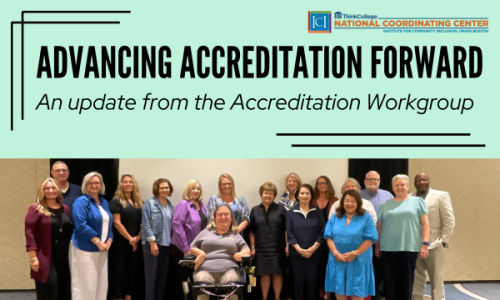
Program accreditation is a critical step for inclusive postsecondary education programs, and The Accreditation Workgroup continues to work hard to develop and refine the process. ...Read more

Check out these tools college programs for students with intellectual disability can use NOW to become familiar with Program Accreditation Standards. 

...Read more

Think College offers a free, online course called “Becoming Accreditation Ready.” Dive into these 11 new modules and prep for future accreditation.  

...Read more

Frequently Asked Questions

Why is accreditation of programs for students with ID important?

Accreditation offers a way to indicate that a program is meeting standards in key areas. Accreditation of programs creates quality benchmarks for programs that are useful to students and parents when comparing programs. It provides legitimacy for programs, as accreditation is the means by which all higher education programs are measured to ensure they are meeting an acceptable level of quality.

How were the accreditation standards developed?

The first National Coordinating Center Accreditation Workgroup was established in 2011 and completed its work in 2015. That workgroup developed, for the first time, model program accreditation standards for these programs by consulting with existing accreditors, working with experts in the fields of higher education for students with intellectual disability and gathering input from hundreds of informants such as family members, educators, and accreditors. The second NCC Accreditation Workgroup began its work in 2016 and concluded in 2020. This Workgroup conducted a field test of the model standards developed by the first Workgroup, held sessions to gather public input, surveyed programs regarding their interest in becoming accredited, and reached out to existing accreditors to ascertain interest in using the model standards. The third workgroup, from 2020-2025, developed and piloted a program accreditation process and developed the first Accreditation Guidance Manual, which shares all program standards along with guidance and required evidence related to each standard.

What was the process used to pilot the accreditation process?

The pilot process began in 2022, and the first program - the University Participant Program at Western Carolina University - was accredited in March 2023. In 2024 - ACE-IT in College at Virginia Commonwealth and Inclusive Services at the University of Colorado at Colorado Springs were accredited. In 2025, Crossing Points Tier 3 at University of Alabama was accredited. The final pilot site was UMatter at University of South Florida, St. Petersburg. Work is now underway to update the Accreditation Guidance Manual as needed, based on experiences and input gathered throughout this pilot process.

Is there an agency whose mission it is to accredit programs for students with ID?

Yes! in March 2023 the Inclusive Higher Education Accreditation Council was founded. The four founding board members of their IHEA Council (a non-profit) all have expertise in inclusive higher education and intellectual disability. The IHEA Council is the decision-making body for program accreditation. 

How many college programs for students with ID have been accredited?

As of October, 2025, there are four accredited college program for students with ID.

What is the timeline for program accreditation to be available for all college programs for students with ID?

The goal is for program accreditation to be open for all interested programs in early 2026. Sign up to receive news and key updates via LinkedIn, Facebook, or the Inclusive Higher Education Accreditation Council website.

What can I do to prepare my program for the accreditation process?

There are many ways you can prepare your program for accreditation. To find all the best resources to help you prepare for program accreditation, review the tools developed by the Think College National Coordinating Center. An introduction to the standards, pre-accreditation self-assessment, and the free online course "Becoming Accreditation Ready" all offer ways programs ways to prepare their program for accreditation. Think College is also available to answer any questions as programs ready themselves for accreditation. Email us at thinkcollegeTA@umb.edu

How can I can learn what is included in the full accreditation process?

The 2024 Guide to Accreditation for Higher Education Programs for Students with Intellectual Disability was released in January 2024. It explains the application, self-study, and site visit processes, and includes the program standards, guidance, and evidence required for review. The Guide is also available in downloadable PDF and as an online manual on the IHEAC website.

Is there a cost to program accreditation?

Yes, there will be a cost for programs to pursue accreditation. The IHEA Council (a nonprofit) has not yet determined the cost but understands the need to keep costs low. Colleges and university leaders are familiar with budgeting for program accreditation costs within their schools and departments to ensure that programs meet the highest standards in a particular field (continuing ed, nursing, education etc.). All program accreditors must charge for the services to cover the cost of the accreditation process.

How do I know if my program is eligible to apply for accreditation?

Find out if your program is eligible for accreditation by the Inclusive Higher Education Accreditation Council by reviewing the accreditation eligibility criteria here.

What if my program serves students with intellectual disability as well as students with other developmental disabilities (e.g., autism)?

While this is a commonly asked question, the answer can vary depending on the specific circumstances. We can help you figure out if your program falls within the accreditation scope of the IHEAC. Contact us at info@iheacouncil.org.