
Peer Mentors

Many, if not most, college programs offer peer mentor support to students attending their programs. Peer mentors are used to provide natural supports around academics, social and interpersonal skills, and getting adjusted to college life. Numerous studies demonstrate the effectiveness of peer supports for college students with intellectual disability and show the impact on students' attitudes and increases in acceptance of individuals with disabilities in the college community. This curated collection of resources includes video guides for recruiting and training peer mentors, descriptions of successful peer mentor models from around the country, research studies, and handbooks to further define various peer mentor roles and responsibilities.
News & Features

These peer mentor handbooks provide ideas for information to share, policies and procedures to adopt, code of ethics for peer mentors, training topics and more.

...Read more
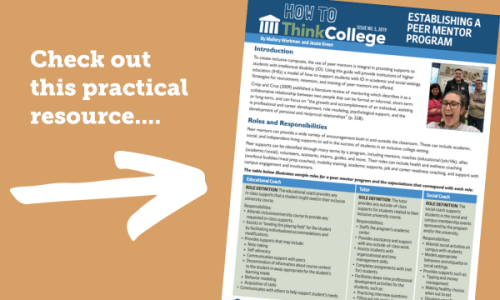
This practical publication from Think College includes tips and strategies from established peer mentor programs. 

...Read more

This training video series was created by an academic support coach at Virginia Commonwealth University ACE-IT ...Read more

Frequently Asked Questions

What is the appropriate role for a peer mentor?

Peer mentors are college students that are committed and interested in supporting students in inclusive postsecondary education programs. Their roles can vary but often include academic support in and out of the classroom, social support on campus and in the community, and residential support in college dorms and apartments. Peer mentors may be paid through work-study or other funds, earn community service or course credit, or volunteer. It is important to note that support provided by peer mentors should be coordinated through the program. For example, peer mentors should support the student to advocate for accommodations in the classroom, but not do the classwork for them. 

What are the skills and attitudes required to be a successful peer mentor?

College students who are to act as support for their peers with ID should fundamentally understand that they are not the boss or supervisor, but rather that being a peer mentor means entering into a mutually beneficial relationship where mentor and mentee are learning and growing together. Look for peer mentors who exhibit traits such as: • Maturity and professionalism • Flexibility • Dependability • Patience and understanding • Eager to learn Experience shows that successful peer mentor have and/or are supported to develop these skills and attitudes: • Setting high expectations • Knowing how to balance fun while being a good role model • Can talk through issues with students in a calm and adult manner • Have a willingness to take on leadership roles and use problem solving skills • Enjoy working with a team • Know how to establish boundaries • Understand the importance of maintaining confidentiality.

What are some helpful strategies to recruit and retain peer mentors?

Being a peer mentor can be fun, but students need ongoing support and communication from staff and each other to stay invested in acting as a peer mentor. Peer mentors can be recruited through college-wide events that are designed to inform all students about clubs and campus activities they can be involved in. Mentors are sometimes recruited by faculty offering peer mentoring as a community service or learning activity as part of their class assignments and activities. Be sure that the opportunity to work as a peer mentor is well advertised on your campus. To retain peer mentors, it is important to offer on-going training and accessible supervision so that they know who to go to when they have questions or concerns. Show appreciation for their time and acknowledge their importance to the students and the program on a regular basis. Look for ways to use the university’s learning management system to stay connected beyond office hours or in-person meetings to connect mentors with each other. Being thoughtful and purposeful with these retention strategies will allow mentors to feel supported, connected as part of a team, and recognized as a valued member continuing to make a difference.

How can we create a schedule and structure for all of our peer mentors?

It is important to remember that peer mentors are also college students with unpredictable schedules. Peer mentors will feel more empowered when they know the expectations as well as when they are needed most. Be sure to take their class schedule into account, and only schedule them for times they are available. Programs should strive to be transparent and flexible with peer mentor schedules and find a communication system that works for them to communicate their availability and volunteer preferences. Use or create a system that shows when mentor support is needed, that allows mentors to sign up for blocks of time, is available on demand, and is flexible, will really help organize peer mentor time. 

How does an inclusive higher education program design a peer mentor application?

A peer mentor application can ask several types of questions depending on the focus area. The application can also be accompanied by a current resume before interviewing potential peer mentors. Basic information to collect on the application is: name, contact information (email/phone), professional references, and why they wish to be a peer mentor. Additional information may vary but could include previous experience working with individuals with disabilities, level of involvement desired as a future peer mentor, and their overall strengths. A sample peer mentor application can be found at here.

What are some benefits to being a peer mentor?

Working as a peer mentor has been shown to enhance personal satisfaction, support the development of new skills, and even change overall perspectives. Peer mentors often have high job satisfaction and a sense of belonging. Working with an inclusive postsecondary education program can also promote a better understanding of workplace diversity and communication that can be transferred to jobs post-graduation. Peer mentoring is a wonderful way to differentiate a job or graduate program application and a great way to build your network! 

Do peer mentors fade support over time to allow for more independence?

Yes – the main focus for peer mentors is to provide initial training and promote independence and then fade support more as students with intellectual disability gain skills needed in their daily routine. This Grab and Go Practice provided by Judi Bean and Maria Paiewonsky offers great ways of fading support as a path to independence.

Other questions about working with peer mentors?