Preparing for College

There are many things that students can and should do, with the support of their family and teachers, to get ready for the transition from high school to college.  Resources on this page include ways to create an IEP that will best prepare students for college, information on important decisions such as guardianship, information on how college differs from high school, and more.  
 

News & Features

Part of any adventure is planning and getting ready - and going to college is no different.  This article shares a number of helpful resources that families and teachers can use to support students to be ready for college.

...Read more

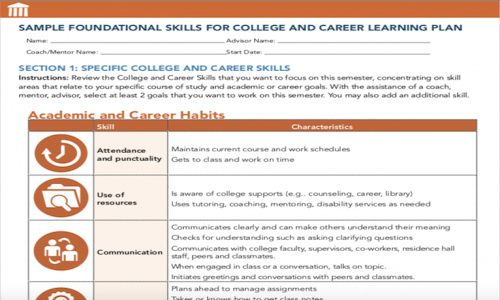
A tool and process to help students work on important non-academic college and career skills.

...Read more

Frequently Asked Questions

What should students and parents be doing in high school to plan for college?

Getting ready for college takes a lot of planning. Use this college planning timeline during grades 9 to 12 to get started on the process. Also, check out this table which provides recommended transition activities and outlines the role of the student, family, transition teacher, and special education administrator.

How can students with intellectual disability prepare academically for college?

Students can anticipate significant differences in the instructional climate between high school and college. This fact sheet summarizes some of the key differences between high school and college and emphasizes the necessary shift to increased student independence. The most noticeable difference is the expectation that college students are expected to manage their own learning and function more independently than in high school. Therefore, it is important to provide students opportunities to develop and practice these skills while in high school. For example, students with ID can be taught to break a long-term assignment into short term goals; they can be taught to maintain a weekly study schedule and modify the schedule as needed; and they can be taught strategies for advocating for assistance when a challenging academic situation arises.

What non-academic skills should students develop before going to college?

To fully prepare students with intellectual disability for postsecondary success, schools and families should address several skills areas that are sometimes underemphasized. Self-determination, organization, time management, goal setting, and technology are all useful skills for students preparing to go to college to work on. 

What strategies can students with intellectual disability use in developing their organizational skills?

Some overarching independent living skills that students will continuously develop before and during college include self-determination, money management, organization, time management, goal setting, and technology use. Some examples of things to practice before living away from home are waking up and getting ready, following a schedule, using a debit/credit card, setting reminders for routines, navigation (e.g., using a crosswalk), making easy meals, doing laundry, and general cleaning skills.

What tools are available to support students with time management?

Many students find time management challenging in their transition to college as they balance their academic, personal, and employment commitments. Students can develop their time management skills by using organizers and creating a daily to-do list to track assignments.  Learning to use the calendar and reminders on their phone will be so useful when they get to college, and will be expected to manage their own schedule!

How can students’ goal-setting skills be developed?

Students with disabilities often enter college lacking academic goal-setting skills. Teaching students how to set long-term goals, break long-term goals down into manageable steps and stick to a plan will serve them well. The I’m Determined website provides a number of templates that address goal-setting designed to help students practice these skills. Helping students set their own goals and also learn how to goal monitor is key. Setting goals that are specific, observable, and measurable will make it easy for the student to determine whether they have prepared a road map for success.

How can students expand their technology skills before heading to college?

It is highly recommended that students begin college with a smartphone and learn to use it as a communication and self-management tool to support their success. Safety is always a number one priority for program staff and families, and one way to ensure that students are accounted for is through their phones. Some ways to prepare students for responsible technology use are encouraging the use of reminder apps, send text messages throughout the day and having them respond, practice phone call conversations with students, and discuss social media etiquette and safety with them. It’s also a good idea to integrate the use of a debit card/credit card to purchase items and to track finances in an app, so students begin learning how to manage their funds.

How can a student prepare to live with a college roommate or roommates?

Living with roommates is an essential part of dorm life! It helps students build accountability and social skills on a different level than just being on campus. Some skills to practice before moving in are cleaning, organization, how to discuss sharing responsibilities, asking for help when needed, social cues (e.g., bedtime, headphone use, door open/closed, oversharing), determining emergent/non-emergent situations, and hygiene.

What adult support services should we be coordinating with to support our child’s college vision?

Interagency collaboration is a wise transition practice to engage in early on. It allows the transition team to quickly and effectively address issues by using the expertise and resources of agencies outside the special education system. Agencies from adult service systems can help students obtain supports that will be needed in a postsecondary setting such as assistive technology, Supplemental Security Income (SSI), and work incentives. Involving a vocational rehabilitation counselor from your state’s Vocational Rehabilitation (VR) agency, for example, can inform the student’s transition team about employment supports the student can access during and after high school. Bringing VR counselors into the transition planning process acquaints them with the student’s interests and can help them understand how higher education will help the young adult achieve employment goals. VR services are generally available to eligible young adults with disabilities when they are 16. If a student qualifies for VR services, the state VR agency may pay some postsecondary education expenses when the course of study will lead to the student’s future employment in an identified career, vocation, or field. 

Still have questions about preparing for college?

Contact our help desk at ThinkCollegeTA@umb.edu