
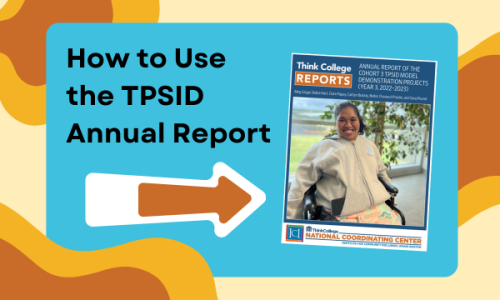
The Transition and Postsecondary Programs for Students with Intellectual Disabilities (TPSID) Annual Report published by the Think College National Coordinating Center (NCC) serves as a valuable resource for various groups and individuals interested in increasing access to postsecondary education opportunities for students with intellectual disability.
Here are some ways people use the TPSID annual report:
Policy Advocacy
Advocates and policymakers use the report to understand the landscape of postsecondary education options available to students with intellectual disability. They can use key data points from the annual report to advocate for increased funding or policy support for inclusive higher education initiatives.
⇒ Do you want to share key data points with policymakers? Use the Executive Summary document (10-minute read), which briefly overviews the full annual report.
⇒ Or, use the Highlights document (3-minute read) to share the most critical statistics, like “65% of students had paid work in 2022-23 through either paid employment or paid work-based learning experiences.”
Program Development
Educators and administrators use the report to identify successful practices and program models TPSID grantees implement. This information helps in developing postsecondary education programs for students with intellectual disability in their institutions or communities.
Key areas included in the annual report like information on Inclusive Courses and Strategic Partnerships can help give insight into some initial program development areas in the Developing a College Program for Students with Intellectual Disability resource.
Research
Researchers use the report as a source of data and insights for studying trends and outcomes related to postsecondary education for individuals with intellectual disability. The report provides valuable information on enrollment numbers, program characteristics, student demographics, and outcomes. Check out the latest published studies using TPSID data and be sure to bookmark our Research Products page:
Evaluation and Assessment
Institutions and organizations involved in providing postsecondary education services to students with intellectual disability use the report to benchmark their programs against national trends and performance indicators. They can assess the effectiveness of their programs and identify areas for improvement.
For example, programs can use TPSID data points like those on Academic and Employment Support provided to students to compare how their own program provides support to students.
Programs can also use the main areas covered in the annual report to design a specialized program evaluation tool. Interested? Check out Western Carolina University’s Target Surveys for Program Evaluation.
Student and Family Guidance
Students with intellectual disability and their families use the report to explore postsecondary education options and make informed decisions about their educational pathways. The report provides valuable information on available programs, support services, and outcomes, helping students and families navigate the transition to higher education.
The Annual Report includes several brief stories that showcase some of the opportunities available to students in TPSID programs. For example, students and families can read about Sebastian’s involvement in Gwynedd Mercy University’s cross-country track team (pg. 2) or how the TPSID program at the University of California Davis is so popular, that they have twice as many students volunteering to be peer mentors than students enrolled in the program (pg. 8).
Many of the data points included in the Annual Report also share important aspects to consider when learning about or searching for an inclusive college program. Students and families can use the College Search Tool to find programs that best meet their wants and needs.
Professional Development
Professionals working in the field of special education and transition services use the report to stay informed about emerging trends and innovative approaches to supporting students with intellectual disability in postsecondary settings. This knowledge enhances their professional practice and supports students with intellectual disability in learning about and preparing for college.
The Annual Report provides an aerial view of what college life and support for students with intellectual disability in TPSID programs entails. Teachers, transition coordinators, and other education professionals can use data points on most accessed career exploration awareness activities or types of residential options to better prepare students for college life.
Funding and Grants
The Annual Report shares an overview of the fiscal sustainability of TPSID programs which includes the annual cost of all programs (pg. 22). Information about common strategic partnerships with external organizations is also highlighted in the report (pg. 22). This information can be leveraged when programs are applying for grants or can even be used by grantmakers and funding agencies as baseline/benchmark information when funding future inclusive postsecondary education programs.
Overall, the TPSID annual report serves as a comprehensive resource that informs various audiences about the state of postsecondary education for students with intellectual disability, facilitates knowledge sharing, and drives continuous improvement in the field.
How will you use the TPSID Annual Report this year?
Already using the Annual Report in your work/life? Tell us how!
Need help finding the right data point for your needs? We’re happy to help! Email us anytime thinkcollegeTA@umb.edu