
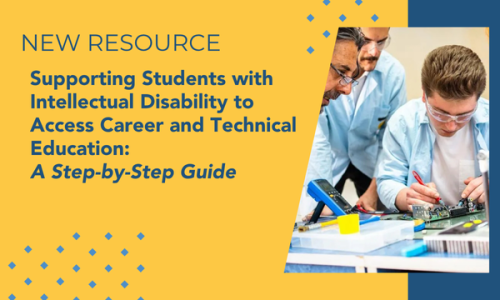
Career and Technical Education (CTE), formerly known as vocational education, has been around since the early 1800’s, with the first federal investment in CTE coming in 1917 with the Smith-Hughes Act. Since then, CTE programs have grown to more than 3,000 across the country. These programs provide foundational technical and academic skills to prepare students for a wide range of jobs, in fields like health sciences, hospitality and tourism, technology, construction, and manufacturing. As such, CTE programs represent a perfect opportunity for students with intellectual disability to earn industry certifications that lead to competitive integrated employment. However, there is still a disparity when it comes to the number of students with an intellectual disability in postsecondary CTE courses. Part of the reason for this disparity is the lack of support available to instructors. That is where this new resource comes in.
To respond to this need, the Think College Inclusive Higher Education Network Career and Technical Education (CTE) Workgroup and the Florida Center for Students with Unique Abilities (FCSUA) wanted to create a resource that people could use to make CTE accessible to students with intellectual disability. Examples are included throughout the resource that provide tangible evidence that these strategies work. To ensure the validity of the resource, it was vetted by the Association of Career and Technical Education’s (ACTE) NextLevel Postsecondary CTE Fellows, who are postsecondary CTE experts from across the country.
How you choose to use the resource depends on the needs and capabilities of your campus. If you have the necessary funding and staff to develop a program for students with intellectual disability on your campus, then you can use this as a guide to help you through the process. If you are unsure if you have adequate staffing to start a program, don’t worry because we have outlined the key team members needed to start developing a program or to engage to put supports in place to serve students with intellectual disability more intentionally on your campus. Regardless of whether you are looking to start a program or enhance the supports available, there is an abundance of research-proven practices that you can implement to support students with intellectual disability on your campus.
Download Supporting Students with Intellectual Disability to Access Career and Technical Education: A Step-by-Step Guide today!
Want to learn more about about CTE? Visit the Association for Career & Technical Education website.