
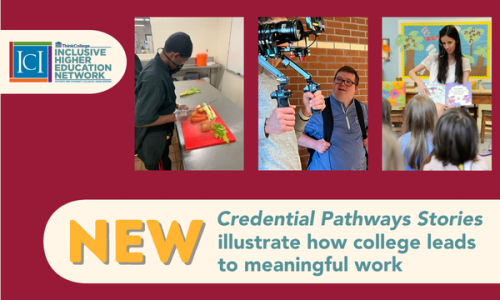
Think College is excited to launch a new publication series: Credential Pathways Stories. This series is designed to shine a spotlight on the transformative role that higher education can play in the lives of students with intellectual disability.
One of the most tangible outcomes of higher education for students with intellectual disability is the earning of industry-recognized or college-issued credentials. These credentials help students gain valuable skills that are directly aligned with workforce needs. Even more importantly, they enable students with intellectual disability to access meaningful employment after graduation.
Credential Pathways Stories bring these successes to life. Each story in the series profiles a student’s journey through postsecondary education, highlighting
- how they pursued and earned a credential,
- what they learned in the process, and
- how the credential helped them achieve their employment goals.
The series offers concrete examples of what is possible when students with intellectual disability have access to inclusive higher education and credential pathways.
Our goal with this series is twofold:
- To educate policymakers, educators, families, and employers about the ways higher education supports students with intellectual disability to build skills and credentials that lead to sustainable employment.
- To inspire the growing community of college programs for students with intellectual disability to consider how they can expand and strengthen access to credentials for their students.
We invite you to explore these stories and use them in your own outreach and educational efforts. Whether you are advocating for more inclusive policies, designing new credential options, or building partnerships with employers, these real-life examples show what’s possible—and why it matters.
The Student Credential Pathways Stories are now available on the Think College website.
If you have a student success story related to credentials and employment that you’d like us to consider featuring, please contact Clare Papay at clare.papay@umb.edu