
In my role as a 2024 Next Level Leadership Fellow, I had the honor of attending the Association for Career and Technical Education’s (ACTE) annual National Policy Seminar in Arlington, Virgina in March 2024. The focus of the seminar was legislation pertaining to Career and Technical Education (CTE) and offered a wide array of panels, sessions, and Capital Hill visits, and shared an abundance of data. We were informed that the current legislative year has been a bit slow with regards to the amount of legislation that has been passed. Keynote speaker Christina Hamilton, Senior Vice President with Gephardt Group, provided the audience with an eye-opening bit of data: In a typical legislative year, an average of 330 pieces of legislation are passed; in the current legislative year, only 34 pieces of legislation have passed. Thankfully, while our politicians have trouble agreeing on a multitude of things, CTE has bi-partisan support.
A few highlights from the seminar:
Short-term Pell funding is a hot topic in DC at the moment. Championed by Senator Tim Kaine (D-VA), the legislation would reduce the clock hour requirement for students to receive Pell Grant funding from its current level of programs with a minimum of 600 clock hours down to 150 hours. The legislation has bipartisan support. While some Senators fear that lowering Pell could result in predatory postsecondary institutions arising to take advantage of students who receive those funds, there are several safeguards within the legislation that would preclude predatory institutions from receiving funds. For example, to qualify for funding eligible institutions must be in existence for at least one year and be able to provide data that demonstrates that students are completing programs; earning recognized certifications; and being placed in careers aligned to their field of study.
In more funding news, Amy Loyd, Assistant Secretary at the Office of Career and Technical Education (OCTAE) spoke about the $7.2 billion that was recently allocated to CTE dual enrollment programs and $120 billion to fund up to two years of postsecondary education for first generation college students.
The Workforce Innovation and Opportunity Act (WIOA) is also up for re-authorization. The House bill is called the Stronger Workforce for America Act (HR 6655) The Act has bipartisan support in the House, led by Congresswoman Virginia Foxx (R-NC), Chair of the Education and Workforce Committee and Ranking Member Bobby Scott (D-VA). It passed the House on April 9, 2024 and has been sent to the Senate. If it passes both the House and the Senate, the Act will increase funding for internship programs. It would also attempt to streamline the Eligible Training Provider List (ETPL) to ensure that program offerings align with the needs of employers. The Senate is currently working on drafting their own bill. • Looking ahead to the 2025 legislative session, the Higher Education Opportunity Act (HEOA) is due for reauthorization. It has been due for a number of years, and Congress may bring it up in 2025. It could review the term gainful employment to create a clear and concise definition as to what the term means and how that data is collected.
The CHIPS Act, signed into law in 2022, continues to expand. The CHIPS Act attempts to reduce America’s reliance on China to produce microchips. Current funding for the Act is at $40 billion. Oregon, Nevada, and Arizona have already been identified as states that will receive some of the funding. The funds will be used to build a manufacturing facility and to train employees in those areas. One of the most important aspects of the seminar were the Hill visits. Attendees were encouraged to set appointments with their Senators and members of Congress. Each group was given information on key legislative issues and state-level CTE. The attention given by the various aides was impressive. They listened and seemed genuinely invested in the issues presented to them. Of particular note was Sarah Mueller, Senator Bernie Sanders’ Disability Policy Director. Sarah is a fierce supporter of inclusive higher education and a staunch advocate for Think College. Senator Rick Scott’s National Security Advisor, Dr. Paul Bonicelli was also very eager to hear about employment strategies used to assist students who complete postsecondary programs, especially those who return to work for their local school districts.
ACTE continues to offer cutting edge trainings and seminars that provide a wealth of information for all who attend. With their eyes set firmly on increasing postsecondary CTE opportunities for students with disabilities, they are a valuable ally in the mission we all share. Information on joining ACTE and attending their events can be found at https://www.acteonline.org/
About the author:
Christian Zimmerman, M.Ed., is a Technical Assistance Coordinator at the Florida Center for Students with Unique Abilities working with existing and potential technical colleges to develop their Florida Postsecondary Transition Programs (FPCTPs). He is currently working with the Think College Network to support the CTE Collaborative Workgroup.
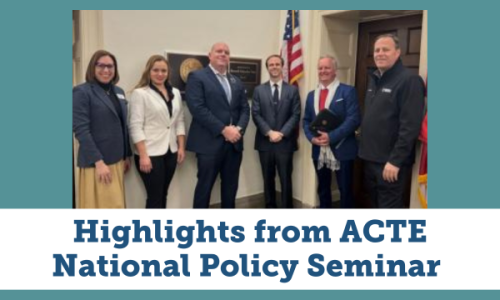
Photo: L to r: Jillian Berg (FL), Kaitlyn VanHeusen (FL), Christian Zimmerman (FL), Alex Weeden (Congressmen Maxwell Frost’s office), Joe Trybus (Valencia College), Steve Darago (Osceola County CTE Director)