
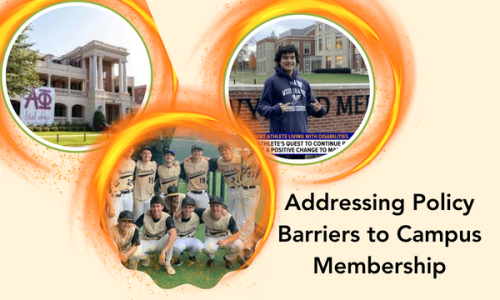
Many college programs work with the administration at their campus to alleviate as many barriers to participation as possible to the non-degree seeking students attending their program. As examples, programs have worked with campus administration to change policies that exclude their students from club sports, student government, and fraternities and sororities. The more activities and services students in your program can access at your college or university, the more enriching and inclusive their college experience will be. Here are some examples of students with intellectual disability who have worked with their college or university to remove participation barriers on campus. These examples may offer ideas on about how you might address current barriers to participation that exist on your campus.
Club Sports
As a freshman, JR Harrison (Class of 2022) made the Vanderbilt Club Baseball team after trying out as a pitcher. This was no surprise – he throws faster than 80 mph. This was a huge deal – he was the first student enrolled in the Next Steps program at Vanderbilt University to make a club sport team. Students, staff, peer mentors, and his new teammates all celebrated the accomplishment. After competing with his new teammates throughout that first semester, he found out he was ineligible in the league they play in - the National Club Baseball Association (NCBA). This wasn’t out of ill will – there just hasn’t been a student like JR before to raise the issue. After nearly two years of JR exercising his patience, members of NCBA officially became valued partners of students like JR and programs like Next Steps. In 2020, they voted to update their rules to allow students enrolled in programs for students with intellectual disability to compete for a spot on their school’s team. And, if they have the skills to make the team like JR did, they will be able to compete against other NCBA teams across the country,. jJust like any other college student.
NCAA Division III Sports
A student in the Integrated Studies program at Gwynedd Mercy University was determined to run track for the Division III school team. However, NCAA rules generally require athletes to be full-time students in degree-bearing programs. The school requested a waiver that would allow the student to join the team, and he was awarded the waiver. This request went even further in removing barriers to participation— - the NCAA’s subcommittee for legislative relief approved a change that will make it easier for students with intellectual disabilities nationwide to compete in Division III athletics, if they have the athletic ability. Under what’s known as a “previously approved waiver,” students with intellectual disabilities will be eligible as long as the program is approved by the U.S. Department of Education as a CTP Program, requires students to make academic progress toward a goal or outcome, allows students to participate in clubs and events on campus, and as long as the students are enrolled full time according to the new rule. Read the NCAA Rule document.
Greek Life
At the University of Alabama (UofA), large fraternity and sorority houses dot the campus, and becoming a part of the tradition of joining these groups is something many UofA students strive for. It is no different for the students in the CrossingPoints Career Studies program. When students in the program expressed interest in rushing for a sorority, the program worked with university counsel and the head of the Panhellenic Association to develop a memorandum of understanding that outlined important considerations for all parties involved to ensure an inclusive Greek life experience for their students who wished to participate. Review these examples: Greek Life Memoranda of Understanding from University of Alabama