
This is a guest post by Abby Goldberg, with Katie Abrams and Desmond Kapayou, all from University of Iowa, where Abby shares how she saw the need for and created an adaptive equipment center at UI REACH, an inclusive postsecondary education program at University of Iowa.
Des’s Story
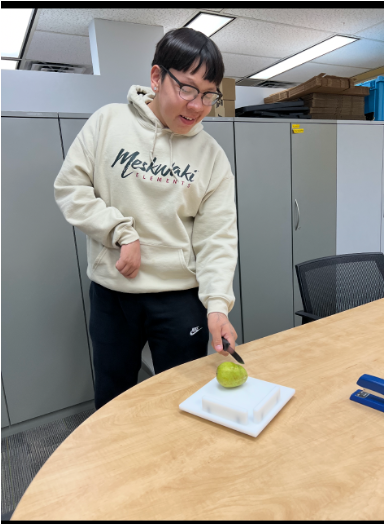
Des, a fourth-year student at UI REACH and proud member of the Meskwaki tribe, has always found happiness in helping to cook meals that connect him to his family and their traditions. Despite facing fine motor challenges, he is determined to cook independently. During a recent cooking lab, Des found it frustrating to chop vegetables, as they kept rolling away. This is especially challenging since Des is only able to use one hand to chop. His instructor noticed and gently asked if he was open to trying an adaptive cutting board designed to stabilize ingredients. Des gave it a try and loved it! With the new tool, he felt confident and determined, turning a difficult moment into an empowered one.
“I used the adaptive cutting board; it was helpful to keep the food in place. It felt safer to use”
-Desmond Kapayou (Student at UI REACH)
Des is an incredible example of how adaptive equipment can promote independence for students. Adaptive equipment is a subcategory of assistive technology and includes tools geared towards supporting individuals in performing specific tasks. Having any kind of assistive technology available for students at your inclusive college program is a fantastic way to foster an inclusive environment. In this blog post, you will read about an example of how a comprehensive transition program, the UI REACH Program in Iowa City, Iowa, brought adaptive equipment to their program and how they educated the whole team about the range of resources available to support students.
What is the Adaptive Equipment Closet and What’s in it?
The Adaptive Equipment Closet at UI REACH provides a range of tools and devices, as well as a list of digital applications that students can try in a comfortable setting. The closet was created after Abby (blog author and Therapeutic Recreation (TR) intern) and an Occupational Therapy (OT) intern observed difficulties students were having when performing a variety of tasks. When they went looking for adaptive equipment across campus, they found none! The OT intern came to Abby with a list of adaptive equipment devices, their functions, links to purchase them, and more, and they got to work. They were fortunate to be able to create the Adaptive Equipment Closet at UI REACH by cleaning out a storage closet, and
- ordering numerous adaptive equipment devices,
- creating binders filled with lists assistive technology applications and web extensions,
- creating a student assessment,
- adding a process to test out the equipment,
- including additional resources to explore,
- and continuously making improvements to this day!
The tools in this closet are categorized into topical areas: kitchen tools, personal care, technology, dressing, and more. Some examples include adaptive kitchen knives and utensils, an automatic card shuffler, electric jar or can openers, and more. In addition to an inventory list of what’s in the closet, there is information posted about local and statewide organizations (e.g., Easterseals Iowa Assistive Technology Program), as well as other products, since this closet doesn’t have everything a student may need.
There are two binders in the closet: the Adaptive Equipment Closet Binder and the Assistive Technology Binder (see Appendix A for sample entries). The Adaptive Equipment Closet Binder includes check-in and check-out sheets and an extensive list of the closet inventory containing QR Codes that link to a video on how to use each item. The Assistive Technology Binder includes apps and web extensions categorized by academics, career, scheduling (including a range of alarm apps), and productivity. For each application or extension, there is a picture of what it looks like, features, availability, and QR codes or links to download them directly.
See the Adaptive Equipment Closet at UI REACH’s in this virtual tour.
Adaptive Equipment: How is the Need Determined?
The process begins when a student needs additional support with some type of assistive technology. The need may be identified by the student, a family member, or staff member. Then a staff member conducts the Adaptive Equipment Needs Assessment, which was developed to gather more data from incoming first-year students regarding adaptive equipment/assistive technology needs they may have in the areas of academics, career, and independent living. This assessment is completed by the incoming student and their parent(s)/guardian(s) either independently or with the support of a UI REACH staff member before they first come to campus. After a staff member reviews the responses, there will either be no follow-up needed or a need for adaptive equipment/assistive technology.
Once the assessment is complete, the staff member involved will go to the closet to see if there is equipment that matches the student’s needs. If the staff find what they were looking for, they will either invite the student to the closet to test out the tool or check out the tool to bring to the student. Either way, if the tool leaves the closet, it must be checked out in the Adaptive Equipment Closet Binder. The student will test the equipment to see if it’s right for them. After the student tests out the equipment, the item must be sanitized and returned to its correct place in the closet. If the item was checked out, it must be checked in in the Adaptive Equipment Closet Binder. If the student likes the tool, the staff will recommend that the student purchase the item and will provide the information to do so. If the student doesn’t like the item or it doesn't provide the correct support, then the staff will repeat the assessment process with the student. See Appendix B for examples of need for support and possible adaptive equipment solutions.
Going back to the beginning of the process, if the closet doesn’t have equipment that matches the student’s needs, then staff will work with the student to find a tool that may be beneficial. If the tool found elsewhere may benefit more students at the REACH Program, it may be purchased to add to the closet. If it is something that might be out of the budget or very specific to a student, then the information will be shared with the student and their family to see if they would like to purchase it. Staff can also provide the student and family with resources that are promoted in the closet to see if another agency has what they're looking for or if they would like to explore more adaptive equipment on their own. A crucial part of the Adaptive Equipment Closet is to document the process in the student’s tracker (UI REACH’s process for documentation).
Key Takeaways and Lessons Learned
It is essential to note that this is just one program’s experience. The UI REACH Adaptive Equipment Closet is the way it is because of the background knowledge and profession of the creators, resources available, and additional factors. However, if you decide to do something like this at your program or are just interested in educating yourself about what tools are out there, here are some lessons learned:
Lesson #1: Do your research. Purchase equipment based on the needs of your population. It may seem exciting when researching equipment to purchase the interesting gadgets out there. However, be mindful of your purchases and keep the needs of the population you serve at the forefront of your mind. Especially if you are just starting or have limited financial resources, make sure you are doing your research on the incredible things that are out there, checking multiple places to find the most affordable price, reading reviews, and don’t forget to check your local agencies to see if they have a tool and might let you test it out before purchasing. You can also check with a local service provider to collaborate on a resource center.
Lesson #2: Patience. Patience is the key to most things in life, including an adaptive equipment center. Chances are, your resource will not be an overnight center. At least the Adaptive Equipment Closet at UI REACH wasn’t. As the months passed, the tools in the closet went untouched. We realized that the staff didn’t know much about adaptive equipment or how to utilize the closet, the student assessment needed some improvements, and the tools purchased didn’t match the needs of the current population that UI REACH served. It takes time to bring ideas to fruition and even more to tweak them to make them successful.
Lesson #3: Evaluate the resources periodically. For example, apps and tools are ever-changing. Some of the electronic apps and web extensions included in the Assistive Technology Binder, had already become outdated and were no longer accessible. It’s crucial to ensure everything is up-to-date and relevant to the students in your program.
Lesson #4: Don’t do it on your own. There are incredible resources out there: colleagues who might want to embark on this journey with you (and some that don’t, which is okay), people at other inclusive college programs, or people from community service providers. Please contact me, Abby, to learn more or brainstorm ideas with me!
Conclusion
There was a lot of information just shared with you, but above all else, know that you are amazing! We encourage you to educate yourself about adaptive equipment, and if you’re feeling ambitious, consider incorporating it into your inclusive college program. You do not need to be an expert to make this happen, you just really need to know your students. Make your closet (or cabinet or shelf) as simple or as complex as you want. Do what will be best for your program and the students you serve. Depending on the support that a student may need, you may not have to buy anything and you could do it yourself. For example, if a student needs help folding their laundry, get a cardboard box, pull up a YouTube video, and make a folding board. Or start by providing your students with applications and web extensions that can support them with the skills necessary for college life. Anything can make a difference, and at the end of the day, we want what’s best for our students, and being able to provide an opportunity for them to gain independence seems pretty worthwhile.
Take a look at another blog post about using adaptive equipment at UI REACH titled, “Putting Together the Puzzle Pieces: One Occupational Therapy Students Capstone Experience in an Inclusive Postsecondary Education Program”.
About the post authors:
Abby Goldberg is a Career Program Specialist at the UI REACH Program located in Iowa City, Iowa. She graduated from the University of Iowa with a Bachelor of Science in Therapeutic Recreation and is now a Certified Therapeutic Recreation Specialist (CTRS). Also, the co-creator of the Adaptive Equipment Closet at UI REACH and the “TR Intern” mentioned in the post.
Katie Abrams is the Transition Coordinator at UI REACH in Iowa City, on the University of Iowa campus. She obtained her PhD in special education from Washington State University where she was the director of an Inclusive Post-Secondary Education (IPSE) program for individuals with Intellectual Disability. Katie’s passions include emerging technology in special education and transition services for students with disabilities.
Desmond Kapayou is a fourth year UI REACH student who is interested in a career in sports and recreation. He recently obtained his coaching credentials to prepare for his future career. Des plans to move home after graduation and work at his local recreation center and coach at a local high school.
 .
. 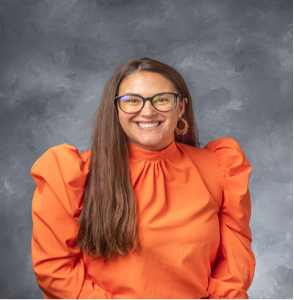
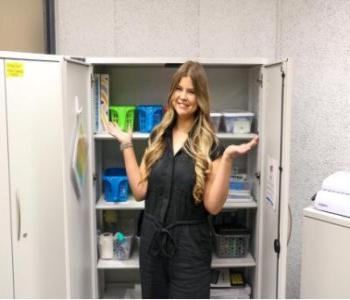
(Pictured left: Abby Goldberg, a woman with long light brown hair in a black jumpsuit smiling in front of the adaptive equipment closet. Pictured right, Katie Abrams, a woman with long brown hair and glasses wearing an orange shirt smiling at the camera.)