
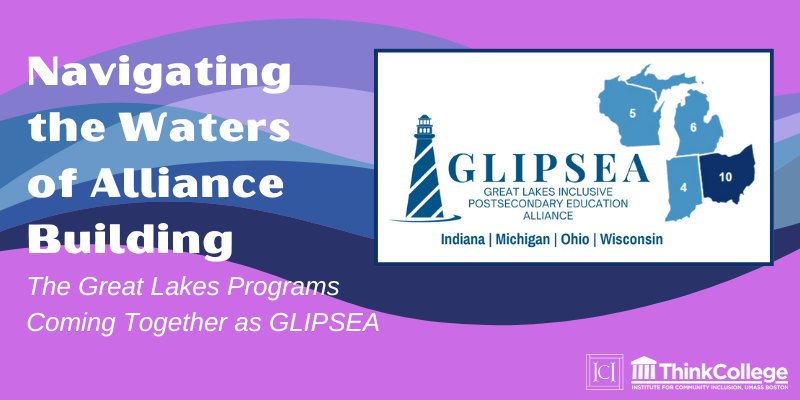
The Great Lakes Inclusive Postsecondary Education Alliance (GLIPSEA), which is comprised of Indiana, Michigan, Ohio, and Wisconsin, has been hard at work over the last year to form our identity and structure as an organization, identify needs within the region, and develop a plan to provide technical assistance and training to professionals in the field of inclusive postsecondary education (IPSE). Our GLIPSEA core team has accomplished just that- by meeting throughout the year both virtually and in person at the State of the Art Conference and at the University of Iowa, in collaboration with the folks from MIPSA (Midwest Inclusive Postsecondary Education Alliance). Our virtual core team meetings continue to be the most fun and enlightening meetings we attend! Despite the fun we have in these meetings, the core team has formalized a board structure, created and analyzed a regional needs assessment, and begun planning our 2nd Annual Capacity Building Institute.
At every gathering of GLIPSEA, there is a genuine commitment to supporting all of our peers, from the seasoned professionals to the growing crop of new and emerging professionals we need to keep this field moving forward. In this relatively small sphere of influence, having access to a responsive support network is invaluable, whether it involves navigating Title IX training for staff or making sense of the myriad of acronyms associated with IPSE. It’s easy to feel alone in a relatively new and growing field, but our time together and the relationships that we’re forming foster a sense of camaraderie and empowerment among colleagues and friends. When you are a small team (or even a party of one!) in a big university system, finding allies and partners who truly understand your philosophy and purpose can be difficult. Having a built-in network of peers to text, call, email, celebrate, commiserate, and/or empathize with has kept each of us in the right headspace to continue moving forward on days when it feels like the barriers are mounting. We help each other and we’re there for each other, as we bond over this shared mission and passion.
As GLIPSEA transitions into another year of growth, we anticipate expanding our reach in providing technical assistance and training to programs in the region. Based on the results of the Needs Assessment conducted in 2023, we learned that our members are interested in learning about a range of program- and student-specific topics including accreditation, program evaluation, admissions, course development, peer mentoring, employment skills development, and social-emotional development. We anticipate supporting our members through our quarterly online GLIPSEA meetings, program outreach, and professional development opportunities.
Through these platforms, members can engage in workshops, seminars, and collaborative discussions tailored to their needs and interests. GLIPSEA will also facilitate resource sharing among colleges and universities within our region, providing access to best practices, curriculum development tools, assistive technologies, and funding opportunities. We get a lot of great information from Think College, but we’re able to take that information and make it more applicable to our specific regional needs and interests. It is our hope that through these professional development activities, our colleagues in the region will be in-the-know on the latest research, strategies, and policies in inclusive higher education and apply these practices to program development and refinement in our respective states. As we grow, we look forward to the connections that everyone around us will build, as we encourage the exchange of ideas and experiences to ultimately improve practices and outcomes for college students with intellectual disability in the Great Lakes region.
To stay connected with GLIPSEA, check out our website or Facebook!
For more information about state alliances around the country, visit this curated resource page. And, to find out about state-level events, legislation, and college programs, visit the What's Happening in Your State page on the Think College website.
About the post authors: John Andresen, Katie Norland, Angela Post, Jessie Green, and Chelsea Stinnett co-authored this post as representatives of GLIPSEA. John Andresen, PhD, is Assistant Research Scientist and Director of Interdisciplinary Training at the Indiana Institute on Disability and Community. Katie Norland, MEd, is Director, Transition and Access Pathways (TAP) at the University of Cincinnati. Angela Post, was the Director of Admission at AbleLight College in Michigan. Jessie Green, PhD, is Research Assistant Professor at The Nisonger Center at The Ohio State University. And, Chelsea Stinnett, PhD, is Technical Assistance Coordinator at Think College.