
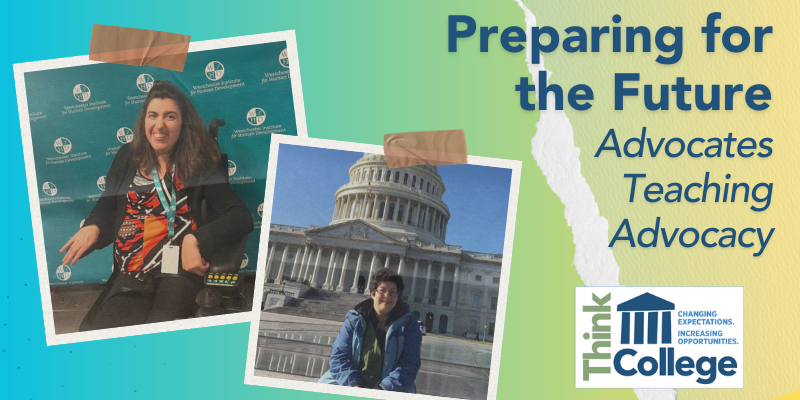
Mindy Lingo, Training Developer for the Think College Network, worked closely with Nichole Hastings and Liz Weintraub throughout the past year. We agreed it would be a gift to all of our followers if we highlighted the work of Nichole and Liz via informal conversations with Mindy-- read on to learn more about the work these amazing women are doing!
“Nothing about us without us” is important to us at Think College, and we want to highlight those individuals who are helping us demonstrate this by teaching college students with intellectual disability how to become advocates. From designing the advocacy trainings to teaching the content, these advocacy partners provide their expertise and experiences to ensure the students are equipped with the skills to become advocates and presenters, so they leave their own mark on disability rights and awareness.
So, let’s introduce these passionate and knowledgeable speakers. First, we have Nichole Hastings, with the Presentation Skills Coaching course offered by the Think College Network in collaboration with the Westchester Institute for Human Development.
Nichole: I am a talented woman with life experience that entails working in the field of disabilities as an advocate for myself and others with intellectual and developmental disabilities. I work for the Westchester Institute for Human Development (WIHD) as the Coordinator of Self-Advocacy & Community Engagement. My job also includes - Leadership Education in Neurodevelopmental related to Disabilities (LEND program) Self-Advocacy Faculty, Vice President of The Self-Advocacy Group called: Hear Our Voices, and Think College Presentation Skills, Course Facilitator, and Curriculum Developer.
Next, we have Liz Weintraub, from Think College Policy Advocates, offered in partnership with the Association of University Centers on Disabilities. (AUCD).
Liz: I am a self-advocate and advocate who encourages others to speak for themselves. I strongly believe everyone should have the opportunity to go to college as well as other opportunities just like everyone else. I work for the Association of University Centers on Disabilities, and I am the Senior Advocacy Specialist. I am also a member of the AUCD's policy team and the host of "Tuesdays With Liz: Disability Policy For All."
Since Nichole and Liz have played a huge role in the success of the Think College trainings, we wanted to recognize the important work they are doing and hear from each of them about what led them to be such influential advocates and how they like putting on their “teacher” hats for these trainings.
What led you to become an advocate?
Nichole: I have been advocating for myself, my services, and my needs for as long as I can remember. Along the way, I thought if I can do it, I want to be able to show other individuals with intellectual and developmental disabilities that they can advocate for themselves and others and what they need. All it takes is for one person to believe in you, and you can do it because that’s what it took for me.
Liz: When I was younger, I didn’t know how to speak up for what I wanted, so I asked a friend to talk to my parents about something that was very important to me. She refused to speak to my parents and told me it was my life, and I should be the one to talk to them. She helped me learn how by taking me to a People First self-advocacy group meeting. Today, I know she gave me the greatest gift that day when she refused to speak for me. Now, I want to advocate for myself and my friends.
What is your favorite part of advocacy work?
Nichole: I like presenting my knowledge to individuals with intellectual and developmental disabilities who don’t know they have a voice yet. I also like presenting to families and other professionals, such as doctors and educators. I really like speaking with young advocates who want to get into this field. It is amazing to see them learn that they have a voice and knowledge from their personal stories that they can share with others.
Liz: My favorite part of advocacy is interviewing people for Tuesdays With Liz: Disability Policy for all, where we help break down policies so my friends and I can understand them and advocate for legislation.
You know the old saying, “Those who can, do; and those who can’t, need those who can, to teach them how.” Let’s hear about their experiences with teaching advocacy. Describe your work with teaching advocacy skills to students with intellectual disability.
Nichole: Teaching students with intellectual disability is actually a unique experience that I am honored to have. I can learn from them where they need help and where they’ve already got the skills, I just have to help them discover how to find those skills and use them to the best of their ability to tell the story in a way they want to and show them how to be in this spotlight.
Liz: I help students to advocate for themselves in Think College Policy Advocates Training. I helped develop and teach the curriculum so students can learn advocacy, information about our government and policy, and the skills and strategies needed to talk with Congress. I teach online and in person in Washington DC, which I prefer over online teaching.
All teachers have their favorite parts of the job and things that can be challenging (or a learning experience); tell us what yours are.
Nichole: I would say the rewarding part of working with students is when they finally are able to discover for themselves that they have a story that is worthy for the world to hear and know about. I don’t like to use the word challenge. I like to use the word learning, for me I think where I learn the most is when a student with intellectual disabilities comes in saying I have nothing to share, or they don’t want to share. They’re just not sure how because they are still dealing with a situation they want to share, but it brings up so much emotion for them at that point in time. It can be hard to help them learn how to share their story in a respectful way.
Liz: The best part is when they advocate for themselves. That’s so cool. I can see their smiles on their faces. The most challenging part for me is sometimes understanding what they are saying or when students don’t pay attention to me by playing around or talking , or not listening. That’s hard because I wonder if they care about what I am saying.
What advice do you have for advocates?
Nichole: Go for it! All it takes is one person to believe in them and their whole world can change in a matter of a second.
Liz: Just be yourself and have fun. I believe that “All means all,” and we all have a seat at the table, and our voices need to be heard.
What is one last thing you would like to share with our readers?
Nichole: Every person with an intellectual disability can do anything they want to do in this world, dream as big as they want to, and do anything they want to. I am also a small business owner, homeowner, adaptive skier, and bike rider, so there is more to me than meets the eye.
Liz: I know the next generation is going to take this world to the next level of advocacy. Recently, I saw a 14-year-old kid on a panel celebrating the Olmstead anniversary and talking about how it helped him and his family to live in the community. And when people say I am their mentor, that really makes me proud.
I wanted to end this blog with something impactful about teaching advocacy, but I don’t think I can say it any better than Nichole and Liz did. Therefore, I'll close with a heartfelt acknowledgment: our team and the many advocates Nichole and Liz have taught to use their own voices are beyond grateful for their dedication to advocating for disability rights and their courage to stand up for what they believe in, as it has benefited so many.
About the post authors: Mindy Lingo, PhD, is a Training Developer for the Think College Network and a former inclusive college program director. She is dedicated to raising awareness and creating opportunities for postsecondary education programs for students with intellectual disability. Mindy particularly values opportunities like this, where she gets to collaborate with students and advocates. Nichole Hastings and Liz Weintraub have already done an outstanding job introducing themselves in the blog post. We would also like to add that their work has been instrumental in developing advocates and empowering them to drive change in disability practices and policy.