
Guest post by Avari Everts, OTDS, St. Ambrose University, with Katie Abrams, PhD, University of Iowa, where Avari shares about her experience as an occupational therapist working with an inclusive postsecondary education program at University of Iowa.
Background
For Occupational Therapists, or OTs, the realm of inclusive postsecondary education is an emerging practice and one they can make a unique and meaningful contribution to. A large part of what OTs focus on is helping individuals become more independent in their day-to-day activities by helping them develop their skills, adapt to their environment, or relearn a skill that was lost. More specifically to college programs for students with intellectual disability, OTs can address many relevant areas such as life, work, academic, and social skills in addition to providing assistive technology and assessing other contextual factors (AOTA, 2020).
My Journey
As an occupational therapy student, I was tasked with finding a topic that I was passionate about and wanted to complete research on. Over two years, I chose to dive deeper into the literature and focused on the role occupational therapy could play within postsecondary education programs for students with intellectual disability. During this process, I was mentored by occupational therapy faculty to design experiential learning objectives for my capstone experience, a necessary step to earn my OTD, or Doctor of Occupational Therapy, degree. For the final step of my capstone experience, I spent one semester working onsite and learning more about a college program for students with intellectual disability, UI REACH, and where I could best see OT fitting into the environment. I collaborated with a variety of staff members and students and learned a lot about where OTs could benefit from IPSE programs.
UI REACH is located in Iowa City on the University of Iowa campus. The program has existed for over 15 years and has grown exponentially during that time. It started in 2008 with an incoming class of 16 students and currently has 76 students enrolled. The program has similar features to other model demonstration programs across the country that serve individuals with disabilities. The program's foundation is built on person-centered planning (PCP) and focuses on academics, student life, social-emotional learning, and employment. Students within the program spend 2-4 years participating in campus and program-specific components which culminates in a program certificate. The program also offers industry-recognized credentials to support students' transition to employment after graduating from the program.
When I first started my rotation, I was largely focused on the transition of students in and out of the program; however, I quickly recognized that OT could offer a unique perspective to a variety of core focus areas within the program to aid in a successful transition out of the program. Therefore, my focus turned away from being largely transition-based and looked more into employment, academics, and independent living skills. Some of the areas I was able to assist in were
- performing work site visits to students’ employment locations and modifying or adapting work tasks for students to be more independent,
- modifying or adapting cooking labs for students to be more independent,
- and addressing independent living and social goals with students.
Additionally, I was able to assist in and teach classes, interview prospective students, and answer or problem-solve situations with other program staff members (e.g., modifying tasks, creating new materials). However, I do believe there are still other areas within college programs for students with intellectual disability where OTs could explore their roles and further identify areas where they could provide unique, important support to college students with intellectual disability.
Takeaways
After a semester of working closely with the Transition Coordinator for the IPSE program, we reflected on some of our biggest takeaways from our interdisciplinary collaboration. Here is the list, in no particular order:
1. Use Readily Available Tools (or Work Smarter, Not Harder!)
There is an abundance of assistive technology and adaptive equipment tools available for almost every skill and need imaginable. Some tools and devices are specifically designed for people who struggle with certain fine or gross motor skills, but others just make sense for any individual and their needs. Through working together, we have compiled an extensive list (see Appendix A here) of some tools that students with intellectual disability in a college program might need to help them achieve certain academic, independent living, and social goals. Some examples include automatic jar openers for students with decreased strength, compact keyboards for individuals with limited dexterity or endurance, or even specific alarm apps like Alarmy for students who sleep through or ignore their alarms in the morning so that they are not late for school or internships.
Example: Students in a cooking lab at the IPSE program at times struggle with reading recipes with certain measuring devices (cups and spoons). Quite a few of the students struggle with differentiating between tsp and tbsp or ½ cup or ⅓ cup while completing recipes. One solution is to use color-coded measuring cups and spoons that correspond with color-coding a recipe sheet for each step in the ingredients.
There are color-coded adaptive recipe books out there (see Appendix B here), however, any recipe can be adapted to match color-coded cups using highlighters or highlighting the text online to correspond. This would allow students to have their own favorite recipes adapted to their specific taste. Appendix C has an example I created with a couple of common recipes.
Example: Additionally, during my time at this site, I partnered with a TR intern and the UI REACH team to create a lending closet for adaptive equipment, which allows students to trial adaptive equipment or gain ideas for assistive technology to incorporate in their daily life and school to improve overall independence. I found many students wouldn’t buy needed equipment because they have never seen it or used it before, which can be scary or frustrating for some of the students. The goal of the closet was to hopefully bridge this gap. The therapeutic recreation intern and I worked together to identify items the office had stored away in addition to a few new items that we felt would be beneficial based on the current student population. With the help of the UI REACH team, we then purchased these items and compiled a list, organized the closet, and linked QR codes with “how to” videos for the students and staff to use for each item (see Appendix D here). Although not a large closet to start, the goal is to continue growing the closet and to introduce new items to students, allow them to test them out, and assist them with purchasing the item, if it helps increase independence for the student
2. Consider an Alternative Viewpoint
It is easy to get into routine at work, so bringing in fresh eyes can help provide a new perspective and alternative strategies or ideas. As an occupational therapist and a set of fresh eyes, I was able to collaborate with the team to help identify new ways or alternative strategies to help students who may struggle with certain tasks. One area I brought a new perspective to, specifically, was supporting students who may struggle to understand tasks within their internship.
Example: One of the students in the program was getting feedback from his employer about struggling to complete his tasks within a timely manner and with decreased support. After multiple site visits, I figured out that the student was struggling to complete the tasks because each shift supervisor was asking the student to complete the tasks in a different order and had different expectations for job completion. So, the student was trying to please each supervisor by doing it their way during each different shift he was working, which made him look like he was unsure of the task and how to do it independently. I asked the student to show me how to complete his tasks, and although he completed them in an odd order, the student was independent. I reported to his primary supervisor that he did know how to do the job; his way just looked a little different. Once the supervisor witnessed the student’s independence, despite the unique pattern used to complete the task, the student continued to have success and ultimately led to a decreased need for site visits.
3. Remember the End Goal: Quality of Life After College
There are metrics to measure independent living skills and happiness ratings of people with disabilities as they enter adulthood. Being able to provide support for individuals to be less dependent on staff while they are in college hopefully will lead to a more independent (and happy!) life after college. One way to accomplish this is to implement some type of assistive technology or adaptive equipment during college, so that the student learns to understand and manage their needs, and can continue to do so after they complete the program.
Example: For instance, a common issue amongst students is being on time, not only for classes, but their internships too. This was sometimes due to losing track of time, but more often, it was due to oversleeping or snoozing their alarms. One thing I started to look at for some students was finding an alarm clock that worked for them. There are several different apps or physical alarms available that are different from the standard alarm you may think of. There are some alarm clocks on the market that not only make noise but will vibrate as well. Other apps require puzzles or tasks to be completed before they can be shut off in order to get a person out of bed. This app was one that I recommended and downloaded for one of the graduating seniors, to increase attendance during the remainder of his time in the program and also help promote independence and punctuality after graduation.
4. Academic Supports for Success
One of the main priorities for college students with intellectual disability is academics, of course. And, like any college student, students with intellectual disability may struggle from time to time in areas like note taking, showing up on time, staying engaged, and other areas. Fortunately, there are ways to help students stay engaged and work towards being more independent and successful learners. A few ideas are as follows: small fidgets to help promote focus and engagement, adaptive equipment to increase independence with note taking and class assignments, and/or apps to assist with completing tasks on time.
Example: A student was struggling with notetaking in her college courses, finding it hard to keep up with lectures and organize her notes effectively. Our team explored a few note-taking apps and settled on OneNote. This app allowed her to type notes quickly, organize them into sections, and integrate lecture recordings directly into her notes. She could also highlight and tag important parts of the lecture, making it easier to review key concepts. After dedicating time to learn and practice using OneNote, her note-taking skills improved significantly. This not only boosted her confidence but also enhanced her academic performance.
5. Come Together: Shared Missions across Disciplines
The collaboration between occupational therapists and college staff working with students with intellectual disability is seamless due to their shared mission: to empower students with disabilities to become more independent and lead meaningful lives within their communities. This alignment has proven beneficial in various settings, such as internships, classrooms, and residence halls. By working together, OTs and college staff not only support the students but also learn effective strategies from each other to implement in their respective practices.
Example: Students lead the process when creating their goals each year. They have academic, social, independent living, and career goals. The student may create the goal, but it can be something they need support with as well. With overlapping missions, multiple professions will provide support in helping them reach their goal. One example of this comes from a student who had a goal to brush their teeth more frequently. It has taken multiple approaches to help this student reach their goal. Adaptive equipment, education, and reminders are just a few of the strategies that took place, all coming from the point of view of different professions. With combined strategies to reach a common goal, the student has become more independent on with this goal and continues to make great strides to achieving full independence.
Closing thoughts
There are many benefits that OT can provide to college programs for students with intellectual disability by collaborating with other team members and, of course, the students! Although these programs already find great success in improving independence within their students’ lives, the OT perspective can further enhance these outcomes. The team at UI REACH (including me, the OT!) received plenty of feedback from students and parents about how much they have appreciated the work that the team has done together and how innovative and helpful the support has been. Hopefully the insights I shared in this article will influence future college programs; I look forward to seeing more OTs working with college students with intellectual disability!
Don't forget to check out some helpful tools and additional resources in this Appendix I created.
Reference: American Occupational Therapy Association (2020). Occupational therapy practice framework: Domain & process (4th ed.). The American Journal of Occupational Therapy, 74 (Suppl. 2), 1-87. https://doi.org/10.5014/ajot.2020.74S2001
About the post authors: Avari Everts, OTD, OTR/L, is a recently graduated occupational therapist from St. Ambrose University in May 2024. Throughout her time in the OTD program at SAU, she completed research on  the role OT could play with individuals with IDD in postsecondary education, under the supervision of her mentor, Dr. Jill Schmidt, OTD, MS, OTR/L, CBIS in partial fulfillment of her OTD degree. To meet her final requirements in the OTD program, she completed a 14-week capstone rotation at the UI REACH program under the guidance of Dr. Kathryn Abrams, Ph.D., where she advocated for the role of OT and collaborated with a team of professionals to help students maximize their independence in academics, independent living, student life, and employment. After graduating, Dr. Everts transitioned into a role as an acute care occupational therapist but continues to be passionate about the work she completed while with UI REACH and within her OTD program at St. Ambrose University. She hopes to continue advocating for the role occupational therapists could play in maximizing independence for individuals with IDD.
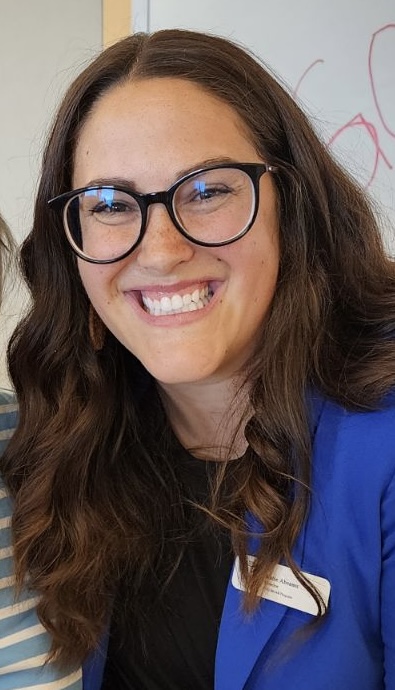 Kathryn Abrams, Ph.D., is the Transition Coordinator for the UI REACH program at the University of Iowa, where she supports students with disabilities in transitioning from education to meaningful careers. Previously, she served as the Director of WSU ROAR at Washington State University, focusing on creating inclusive educational and vocational experiences for students with intellectual and developmental disabilities. Dr. Abrams is an advocate for workplace inclusion, and her research interests include emerging technology to support students with disabilities, evidence-based practices for transition, and inclusive post-secondary education.