
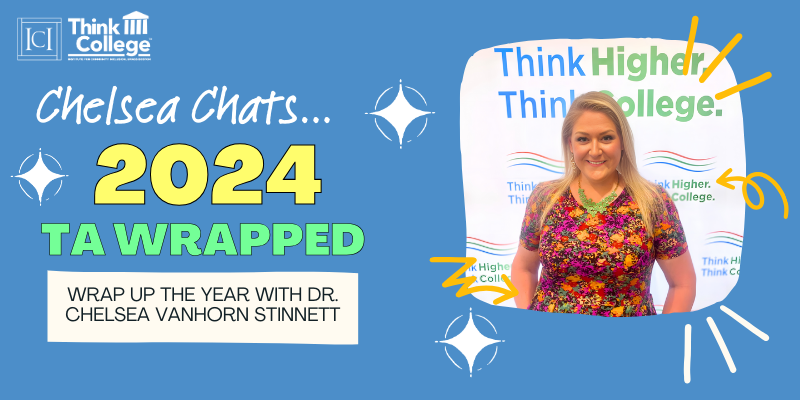
Each year, I am in awe of what the Think College technical assistance team accomplishes. Altogether, about 12 of us answer calls and emails (or “tickets”) from people around the country (and the world!) looking for guidance and support about college options for young people with intellectual disability. I’ve always been part of teams that work really hard, but something about this team is different!
Since January 1st, 2024, we have received 1,512 tickets from 1,104 customers in our helpdesk system. Our team spent 626 hours, 6 minutes, and 48 seconds responding to these requests. I don’t know why these numbers always surprise me, but they do, and they are worth celebrating. The effort, energy, and passion dedicated to every call and email we answer is evident in every exchange. We’re excited and motivated by watching these numbers go up, year after year, because that means we’re doing what we set out to do, and then some, in creating equitable opportunities in higher education for students with intellectual disability.
Our helpdesk (thinkcollegeTA@umb.edu) is the “landing site” for all on-demand technical assistance requests across all our projects. (Want to know more about what we mean by “technical assistance”? Read this post I wrote recently.) We use several measures to track the technical assistance we provide, but our helpdesk provides some awesome metrics I wanted to share that really highlight the work we did as a team in supporting and building capacity in the field of inclusive postsecondary education.
I noted previously how many emails and phone calls we responded to (over 1,500!). Some of those inquiries came from people outside the US: from over 25 different countries! When inquiries can be “solved,” our helpdesk generates a satisfaction survey.124 surveys were completed since January 1st, all with 100% “great” ratings on the support provided by our team.
Besides one-on-one support, we supported professionals and other key partners in our work through Think College Groups, hosted on Facebook.
· Our Transition Professionals group, which consists of people across disciplines and agencies that support students with intellectual disability in transitioning to life after high school, grew by 161% and now has 303 current members. This group is facilitated by my friend and colleague, Mindy Lingo, who is working so hard to bridge the gap between secondary transition and inclusive postsecondary education.
· Our Program Professionals group, which includes individuals who work at or with postsecondary education programs for students with intellectual disability, grew by 22% and now includes 648 members. Each day, we have program staff sharing experiences, tools, and tips with each other in the most authentic and selfless ways. They make this group great!
· Finally, our longest-standing group, Families, grew by 21% since January 1st and now includes over 3,000 family members supporting their loved ones in navigating inclusive higher education opportunities. Olivia Fraioli, the newest member of our Think College team, moderates this group and works hard to share resources for current and prospective students and family members each week.
Within the Program Professionals group, we hosted 7 “Coffee Chats,” informal, semi-structured meeting for program staff to discuss important issues and time sensitive topics, while sharing information, resources, and experiences. Across these seven events, we had 191 participants and 100% agreement that they would attend a future event. I’m really proud of the community we’ve created for each partner group, and having served as a program director before coming to Think College, I’m particularly excited about how we continue to support emerging professionals and researchers in the field.
Lastly, a point of emphasis within the Inclusive Higher Education Network has been providing targeted technical assistance to state and regional alliances. This work is guided by our Alliance Manager, Susanna Miller-Raines and facilitated by several of our team members. Since January 1st, we have collectively provided a little over 400 hours of technical assistance to developing, emerging, and established regional and state alliances. WOW!
While each of these stats are impressive, it doesn’t include the other ways in which our team has advanced and supported the field at large in the past calendar year. We’ll save that for a future blog post.... To say that I’m impressed with what we accomplished in providing guidance, support, and training is an understatement. These numbers are a true testament to a team effort to promote and support the growth of inclusive postsecondary education. It’s amazing to see what can be accomplished in a year!