National Coordinating Center

Students with intellectual disability (ID) are a new kind of college student, as there was no clear path for these students to enter college until recently. Changes to the Higher Education Act in 2008 created a new type of college program that offers alternative admission to those students with ID that wish to continue their education after high school. Close to 300 colleges and universities in the United States offer such a program, and faculty at those colleges are experiencing students with these kinds of disabilities in their classes.

Project
National Coordinating Center

What Does Accreditation Really Mean?

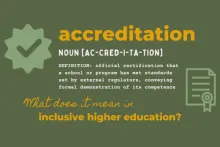
dictionary definiton of the word accreditation

This blog post from Accreditation workgroup chair, Dr. Martha Mock, shares her thoughts on the ongoing and important work of the Workgroup.  She shares her thoughts on what program accreditation means for students, family members, college faculty and program staff, and what each of those groups can do NOW to get involved.  Read the full blog post. 

This webinar focuses on how faculty support students with intellectual disability enrolled in their college courses. Two professors share their experiences in supporting students with intellectual disability enrolled in college success and leadership classes, and the importance of having a support system in place to aid students in- and outside the classroom. Adjusted assignments and assessments will be discussed that support students’ development. 

Project
National Coordinating Center

Cate Weir, Project Coordinator for the Think College National Coordinating Center, was interviewed by Mickie Hayes, Director (Retired) of the Florida Consortium on Postsecondary Education and Intellectual Disabilities. Mickie is host of a podcast called College, Disabilities, and Success. In this episode (#40), Cate shares how college can be a meaningful, productive, effective opportunity for your child with an intellectual disability to gain skills that can lead to effective competitive employment.

Project
National Coordinating Center

This Insight Brief describes how the COVID-19 pandemic impacted college students with intellectual disability (ID) enrolled in the colleges and universities offering TPSID programs. During the COVID-19 pandemic, most colleges and universities transitioned to some form of remote instruction. Many students with ID moved off campus, accessed their learning experiences and associated accommodations in new ways, and dealt with changes in their internship and employment experiences (Madaus et al., 2021; Papay & Myers, 2020; Sheppard-Jones et al., 2021).

Project
National Coordinating Center