
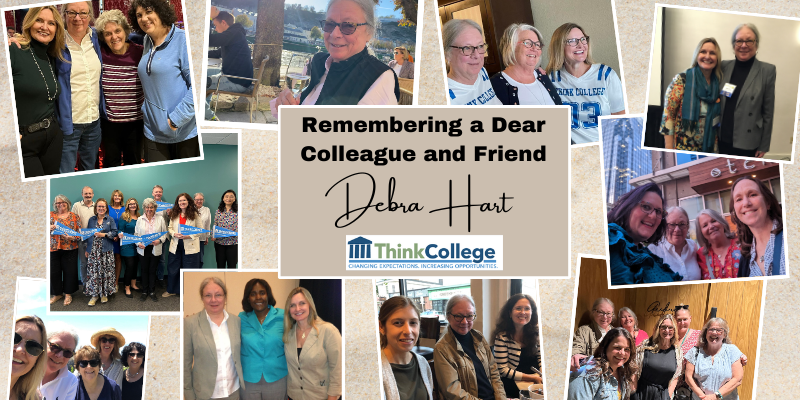
This week brought a devastating loss to our community, to the Think College team, and to me personally. Our beloved colleague, intrepid leader, and my long-time friend and colleague, Debra Hart passed away unexpectedly.
For those of you who knew Debra, this news will hit hard. She has been a visionary leader in the field of disability, special education, and higher education for 30+ years. My guess is some of you reading this will immediately think of a recent conversation, a time she helped you in your work, or even back to the first time you met her. Because you would not have forgotten your first meeting with Debra Hart.
She was one of a kind.
At first glance, you might not realize the power and impact she had. In her jeans, flip flops, army green jacket, and untamed mane of grey hair, she did not look like an academic. She was soft spoken and incredibly modest. She did not seek or enjoy the spotlight. But her unassuming persona belied a character made of steel, and values that were unyielding.
You would be mistaken to underestimate my friend, Debra Hart.
Though her Canadian roots required her to be kind and polite in mixed company, she did not mince words when it came to her thoughts about inclusion. She believed everyone should have the opportunity to learn, that nobody should be segregated, and that the systems preparing and supporting people with disability, especially those with intellectual disability, needed to be revolutionized.
And she was the right person to make that happen—because Debra was a revolutionary.
Her early career at the Institute for Community Inclusion focused on working with transition-age youth, supporting self-determination and access to assistive technology, and inclusion. With local school districts and state agencies in Massachusetts, Debra worked on over 12 different grant funded projects in the 1990s and early 2000s.
This is how Debra Hart changed the system, one grant funded project at a time. She was prolific when it came to grant writing. Each project advanced her knowledge of what worked and increased her positive impact on the lives of people with disabilities. Each new grant also expanded the large network of people she partnered with to make these systems better. To make the lives of people with disability better.
While her personal use of technology was, let’s just say, challenging, she knew it was the key to success for students with disability. She also knew it was never too early to think about college. For the past decade, Debra sought to empower students with and without disability in middle school and elementary school to build their college dreams via Think College’s Future Quest Island projects.
Debra also was committed to improving transition services. She helped train special education personnel through the UMass Boston Transition Leadership graduate certificate program, and she spearheaded the inception of the Massachusetts Inclusive Concurrent Enrollment (MAICEI) program. Her visionary leadership transformed the educational landscape by providing inclusive opportunities for high school students with disability to access higher education. This program continued to grow through state funding, making it one of the strongest examples of college-based transition service in the country. The program recently expanded to support access for adults with intellectual disability in the state and Debra was integral in that work as well.
While her professional contributions in many realms were admirable, Debra’s greatest impact has been in the field of inclusive higher education. Like with her early work, Debra’s commitment to seeking funding support for policy, practice, and research advancements contributed significantly to the progress made in inclusive higher education. Over the past 15 years, she helped lead multiple groundbreaking projects, like the Think College National Coordinating Center, the Think College Transition Project, and most recently, the Think College Inclusive Higher Education Network. This work led to partnerships and collaborations with so many of you reading this today, and these collaborations have contributed greatly to the foundations of our knowledge in this field.
What Debra loved most was working with people to solve problems. She traveled all over the country working with families, school systems, colleges, and educators helping them figure out their next steps, big or small. She talked with hundreds, if not thousands, of family members, supporting their dreams of high expectations, and helping them plan to make their dreams come true.
Debra also created a strong Education and Transition team here at the ICI, filled with amazing leaders who have generated significant changes in research and practice in the fields of transition, employment, college-based transition, technology, and inclusive higher education. As a colleague, Debra would talk or problem solve, take a risk on an innovation, and cultivate new partnerships. As a friend, Debra cared about each of her colleagues as people first, asking about our kids, our moms and dads, and, of course, our dogs. She loved hanging out with us outside of work and catching up in real and meaningful ways. She had a tender heart, and you were lucky when she shared it with you.
We were lucky because she shared it with us.
As for me, it still does not feel real. She has been my professional partner for almost 20 years. Hart & Grigal, Grigal & Hart. That’s been us for a long time. I am incredibly lucky to have been her partner in this amazing work, and I am so grateful to my colleagues who have come together to hold each other up as we grapple with this new reality.
I know Debra’s work and voice have touched so many of you. We have received so many kind thoughts in the past few days and each message means so much to all of us. Our team will continue to share other ways we can honor and remember Debra’s impact in the coming weeks and months. But, for now, please know we are with you in our hearts, share in your loss, and we are grateful to have been a part of Debra’s incredible life.
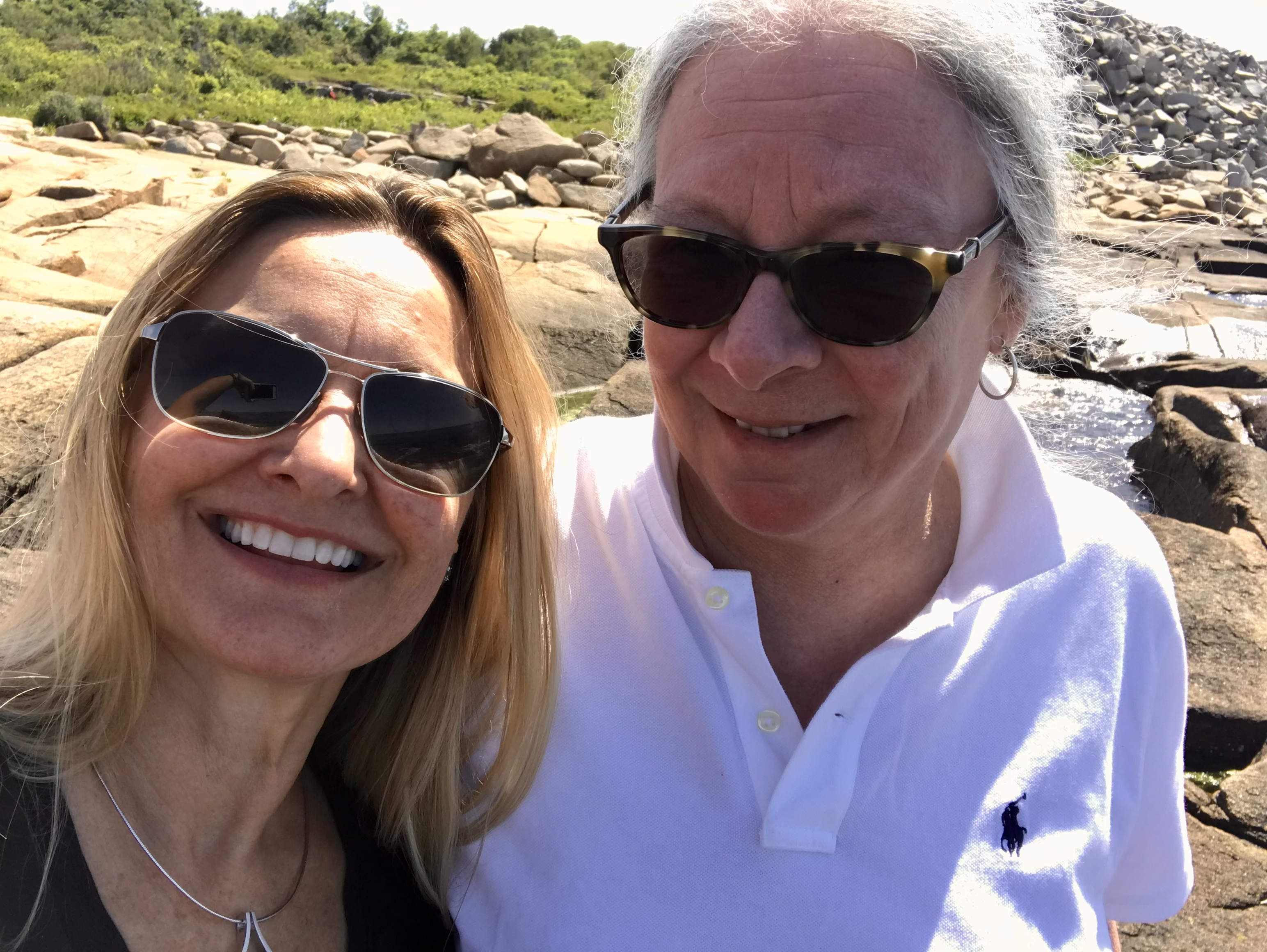 About the post author: Meg Grigal, Ph.D. is a senior research fellow at the Institute for Community Inclusion at University Massachusetts Boston and the co-director of Think College where, she serves as a principal investigator on a variety of research grants including the National Coordinating Center for the Transition Programs for Students with Intellectual Disabilities (TPSID) Model Demonstration Programs, the Think College Inclusive Higher Education Network, and Future Quest Island Explorations, a Stepping Up in Technology project. When not at work, Meg is a mom to a college junior (Go TERPs!!) and a high school senior (no idea where he’s going yet!!). She loves to garden, hike, and brew up cool concoctions with essential oils.